I didn’t get a 7.5 on IELTS by luck.
It came from consistency, careful planning, and a mix of learning strategies that worked for me—not just “work harder.”In this post, I’ll walk you through how I prepared for all four sections—Listening, Reading, Writing, and Speaking.
I attended prep classes, practiced with mock tests, and used platforms like AmazingTalker to improve my speaking skills.I’m not claiming this is the best or fastest method for everyone. If you’re looking for a grounded and honest way to study, this will help. It can help you find your own rhythm without burning out.
Why I Took the IELTS?
The reason I decided to take the IELTS was simple. I was preparing to apply for graduate schools in the U.S. and the U.K. I needed a solid language score to support my applications.
I chose IELTS over TOEFL because it simply fit me better.
📍TOEFL’s reading felt too academic and tiring, while IELTS passages were long but easier to digest.
📍I found IELTS listening more manageable and less stressful.
📍I didn’t want to talk to a computer—speaking to a real person felt more natural.
📍And although IELTS writing was tough, I actually enjoyed the long essay topics more than I expected.
It matched how I think and study, and that made all the difference
IELTS 7.5 Equals What in TOEFL or CEFR?
📊 IELTS 7.5 Equals What in TOEFL or CEFR?
If you’re wondering how IELTS 7.5 translates into other language test scores, here’s a rough comparison:
- TOEFL iBT: Approximately 102–109
- CEFR: Generally C1 level
- TOEIC: Around 945+
Keep in mind that these are rough conversions. Different universities or programs may interpret them slightly differently, so it’s best to check with your target school’s admission page.
resources: Cambridge English、IDP IELTS
My Study Principles & Daily Plan
I treated IELTS preparation like a long-term habit, not a sprint.
I didn’t study 10 hours a day—I focused on consistency and quality.
I didn’t rely on just one method. I took a prep course, used official practice tests, and scheduled 1-on-1 speaking sessions on AmazingTalker. I also reviewed YouTube videos and Reddit discussions to get familiar with question patterns and recent trends.
I adjusted the schedule based on my energy and progress. I always kept a weekly checklist. This ensured I wasn’t avoiding my weak spots.
Reading
How I Improved My Accuracy & Speed?
My Usual Approach
- Start by reading the questions first, and underline important keywords—like names, dates, numbers, or special terms.
- Then, read the first paragraph, keeping those keywords in mind.
- Check if you can find the answer to any of the questions in that paragraph. If yes, write it down.
- If not, go to the next paragraph, and repeat the same process until you locate the answer.
This step-by-step approach helped me:
- Build a mental map of the passage before diving in.
- Avoid wasting time on details I didn’t need to understand yet.
- Keep track of progress by tracking a “read and match” rhythm.
Tip: Know if the Questions Are in Order
One key strategy for the reading section is to check if the answers are in order. This means you should verify the answers to questions 1, 2, 3, and so on. Make sure they are sequentially in the passage.
Why this matters:
If the questions follow the paragraph order, it’s much easier to track answers. You can move quickly through the text.
If the questions are not in order, like with some diagram or matching questions, you’ll need to jump around more. Pay extra attention to wording.
👉 In my experience:
Diagram/matching questions often don’t follow order, so you need to scan the whole section carefully.
Sentence completion and short-answer questions usually follow order.
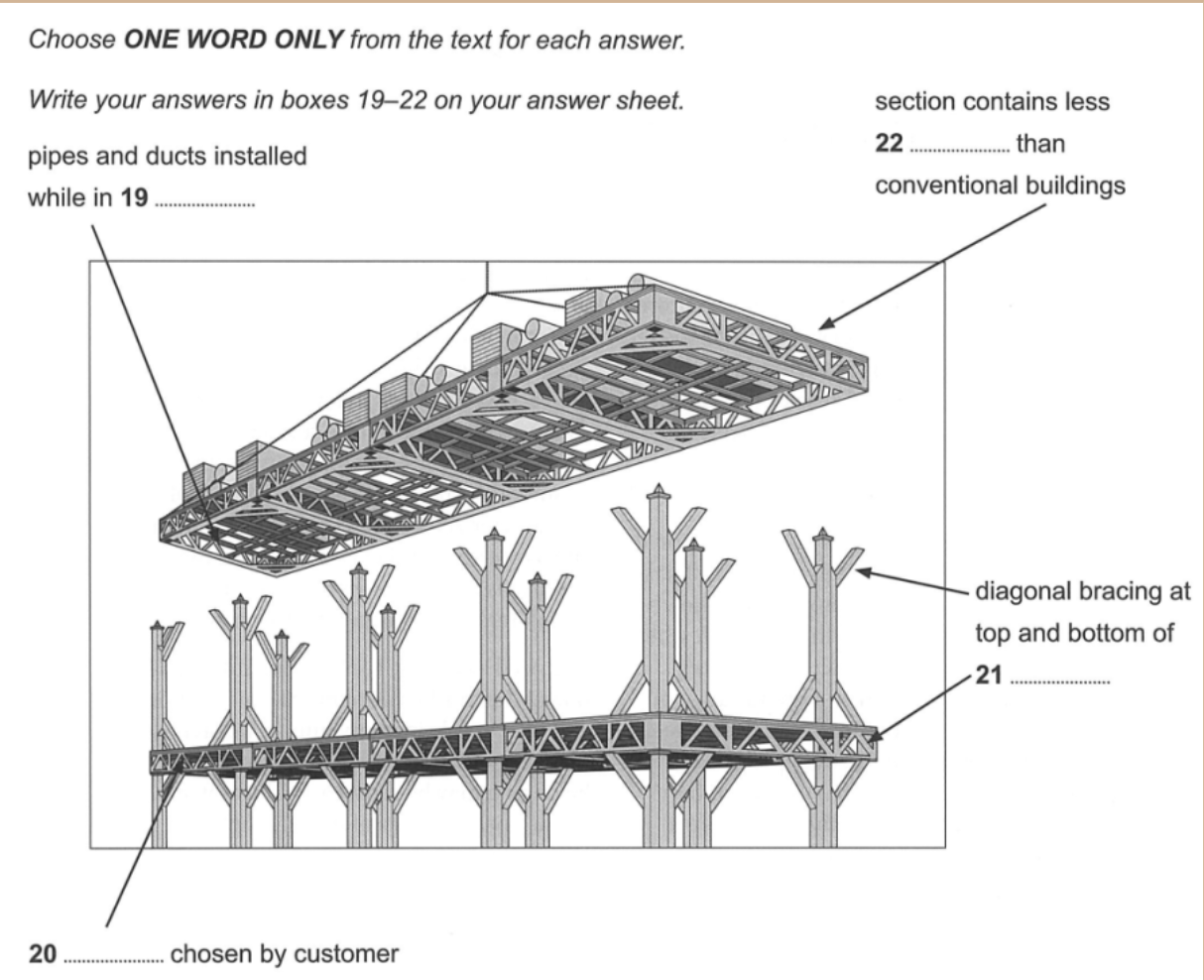
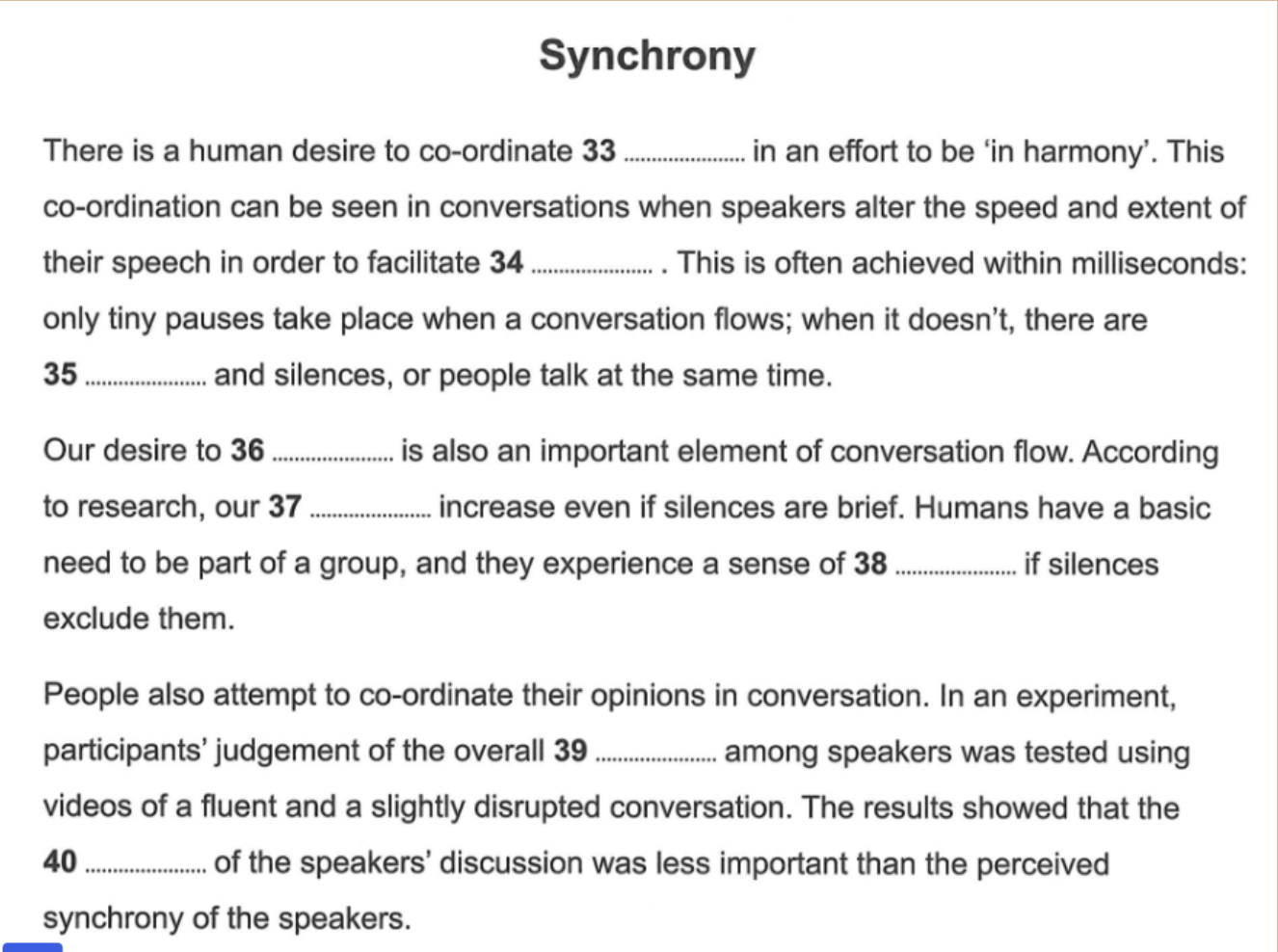
Use Keywords and Contrast Words to Find the Main Idea
Sometimes, IELTS reading passages are long and abstract—and that makes finding the main idea feel tricky. But there’s one powerful trick: look for contrast words like “but.”
Let’s try this with a real paragraph.
📖 Original text:
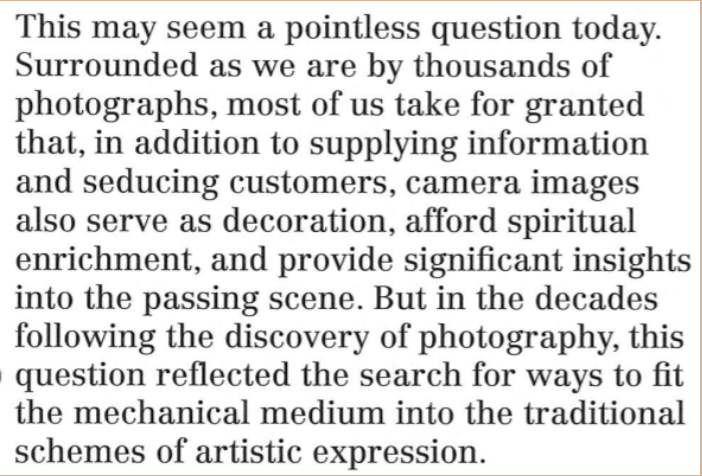
This paragraph feels long, right? But when you zoom in on the sentence that begins with “But”, everything becomes clearer. This is the real focus of the paragraph.
🔍 In the early days, people were figuring out how to fit photography into the world of traditional art.
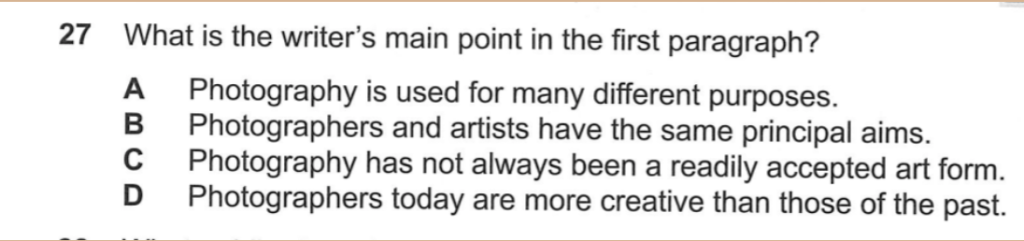
🎯 Correct answer (C): Photography has not always been a readily accepted art form.
💡Tips:
Highlight key nouns (like mechanical medium, traditional art, photography) to keep track of the central ideas.
Use transition words like but, however, while, yet, etc. to find shifts in meaning.
When you spot one, ask: “Is this where the author is revealing something more important or surprising?”
Keyword Highlighting & Paraphrase Matching
IELTS reading rarely repeats the exact words from the question in the text. Instead, you’ll need to find paraphrased versions—different words with the same or similar meaning.
So how do you find the answer?
- Underline keywords in the question (especially names, years, or technical terms).
- Look for matching ideas in the passage—not identical words, but similar meaning.
- Understand paraphrasing, including synonyms, rephrased phrases, or idea-level substitutions.
💡 Example:
Question: Many animals sleep for long periods in winter.
Passage: Many animals hibernate during winter.
You won’t find “sleep for long periods,” but “hibernate” means the same thing. This is why building your paraphrase recognition is key to improving your score.
✨ Paraphrasing Is Key for Fill-in-the-Blank Questions
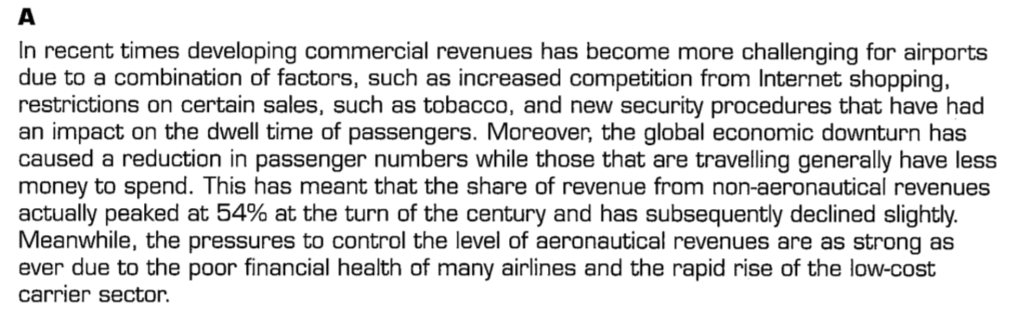
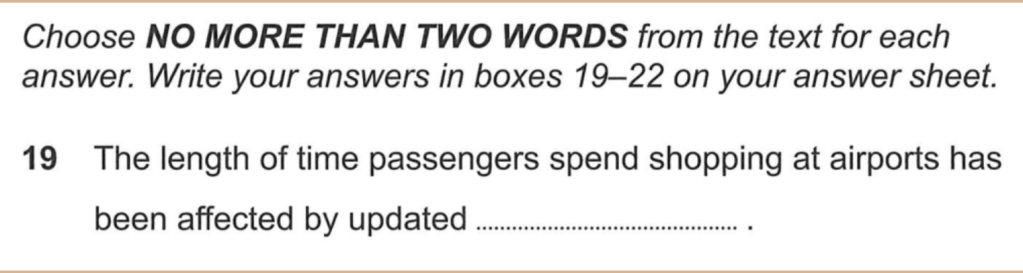
After reading the passage and the question, try to answer it. Look for paraphrased concepts instead of exact word matches.
(You’ve got 30 seconds—go! ⏳)
📍 The answer to this question is found in paragraph A, lines 3–4:
new security procedures that have had an impact on the dwell time of passengers
Let’s break down where the paraphrasing happens:
- “updated” in the question = “new”
- “affected by” = “had an impact on”
- “length of time passengers spend” = “dwell time”
🎯 So the answer is security procedures! 🎉🎉🎉
🔊 Listening
Among all the IELTS sections, listening was the one I felt I can handle the best. That doesn’t mean it was easy. One advantage of the IELTS Listening test compared to TOEFL is that it’s more “human.” You’ll hear more conversations and everyday contexts, though there are still academic topics as well.
I believe that with enough effort, everyone can make great progress in this section! 🙋♀️
1. Combine Practice Questions + Podcasts + News Listening
(Recommended: 6 Minute English – BBC)
Ideally, you should be capable of understanding full passages. Once your brain is used to tracking the content, filling in the blanks or answering questions becomes much easier!
To build up this ability, I suggest listening to English podcasts or news that actually interest you. 💡
If something’s hard to follow, slow it down to 0.5–0.75x speed. Also, mimic the speakers’ pronunciation and intonation to help your brain form memory links.
When practicing IELTS questions, try looping the same tricky section several times. Once you get the idea, start “listen + write” mode. Repeating this will definitely move you ahead.
2. “Pauses, Hesitations, or Emphasis” Often Point to the Answer
(Recommended: Using These Listening Tips)
Some listening questions include accents from the UK, US, or even India, which can catch you off guard. These variations often increase the difficulty.
But, if you notice a sudden pause, repetition, or shift in tone, there’s a good chance the answer is nearby. 💡
That’s also why it’s important to stay alert! If you zone out for even a second, you will miss the keyword. In that case, skip ahead and focus on the next question—you can’t afford to get stuck.
Speaking
If you’re someone who’s pretty thick-skinned, then the IELTS speaking test actually is your big advantage—haha!
The first thing is: be brave! Don’t feel embarrassed. Just having the courage to speak already means you’re halfway there.
The IELTS speaking score is based on four criteria:
Task Achievement, Coherence and Cohesion, Grammatical Range and Accuracy, Lexical Resource
(You can check out how IELTS English Academy teachers break this down.)
If you want to aim for a high score, you need to make sure your answers are well-structured. Use a variety of sentence patterns and vocabulary. Make sure your responses are fluent with few hesitations or major grammar errors.
To achieve that, I highly recommend practicing every single day.
💡Even broken-up 10 or 15-minute practice sessions are helpful. You can gradually improve your fluency and reduce test anxiety with this regular repetition.
The best method is finding someone to practice with! Whether it’s a tutor or another candidate, having a partner will allow you to simulate real test conditions. It will help boost your speaking score a lot.
🎯Tip: Mastering “one story, multiple uses” is a game changer
Let’s say you’re preparing for the common question, “Describe your most recent trip.”
You can develop a core version of your story like:
I traveled with my friend to Tainan. We visited cultural landmarks and had some amazing street food. We wrapped up the night at a cozy bar chatting over drinks.
The key is to make the story vivid—add emotional details, what stood out to you, what you learned.
This way, your story feels authentic and can easily fill up 2 minutes.
Now, ask yourself: how many different questions this single story can be reused for?
🧠 Five common IELTS speaking themes:
1. Interpersonal | 2. City life | 3. Celebrations | 4. Culture | 5. Travel
Learn to reuse stories across topics, and you’ll be much more prepared for unexpected questions!💡💡
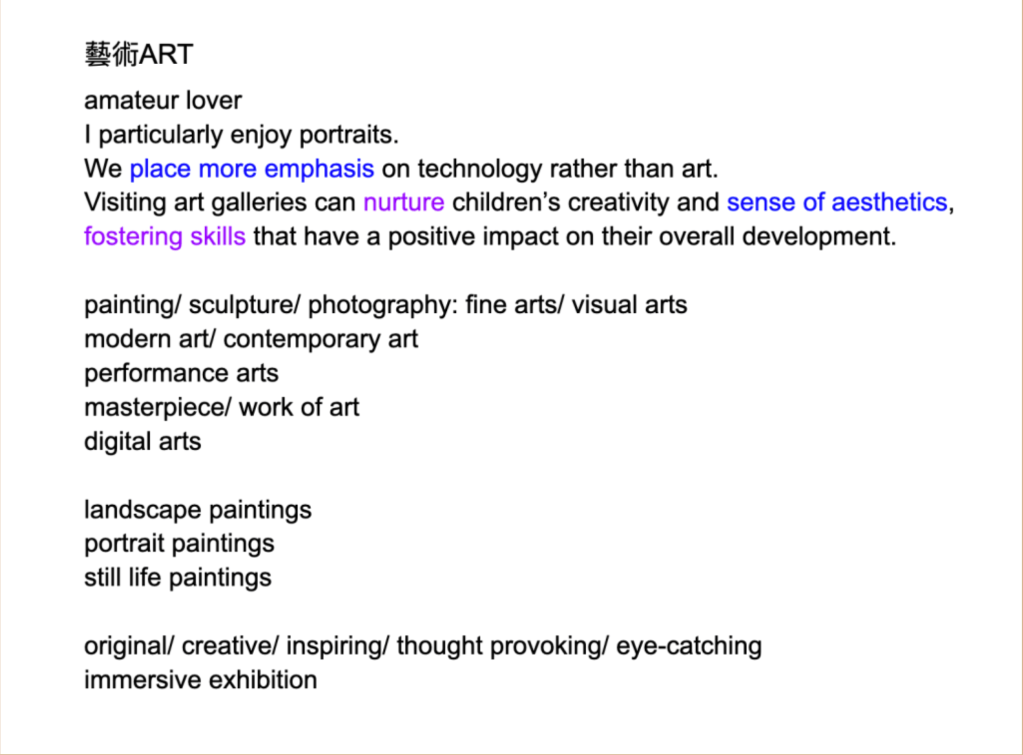
Example: Vocabulary notebook strategy
Let’s take Art as an example.
I write down relevant vocabulary and sentence patterns that help me expand answers on this theme during the test.
This helps me deepen and widen my response when facing related questions.
🎤 Build your story with a simple framework:
What? Where? Who? Feelings? Future?
In IELTS Speaking Part 1, you’ll usually get easy intro-style questions (these are not really scored).
Part 2 gives you a single topic to speak about for two minutes, and Part 3 is a deeper discussion.
If you can speak Part 2 well, it sets you up for a strong overall score.
Personally, I always build my Part 2 answers using that story structure above.
It helps me keep things flowing and prevents me from freezing or ending too early.
If you can speak fluently, stay relevant, and show good vocabulary, your score won’t be too bad. Even without being “perfect," you can achieve a good score.
Writing
Writing is the most frustrating part of the IELTS test for many people. In my experience, you need the clearest structure. You must also invest the most time if you want to get a high score.
The writing section includes Task 1 and Task 2:
- 📌 Task 1 usually includes charts, process diagrams, or maps.
- 📌 Task 2 is an essay question.
📊 Writing Task 1 – Common Chart-Type Strategy
Step-by-step structure (using chart-type tasks as example):
1️⃣ Introduction
- Start by briefly introducing the chart: What is it about? How many items? What units? What time frame?
- Then give an overview: What major trend is shown in the chart? For example, overall increase or decrease, big changes, similar trends, etc.
✅ Important tip:
- Stay neutral. Do not include your personal opinion.
- Focus on the big picture and group data properly (by time, by trend, or by category).
- Avoid lengthy background – jump straight into analysis using clear comparison phrases.
📊 Sample Writing Template for a Common IELTS Task 1 Chart
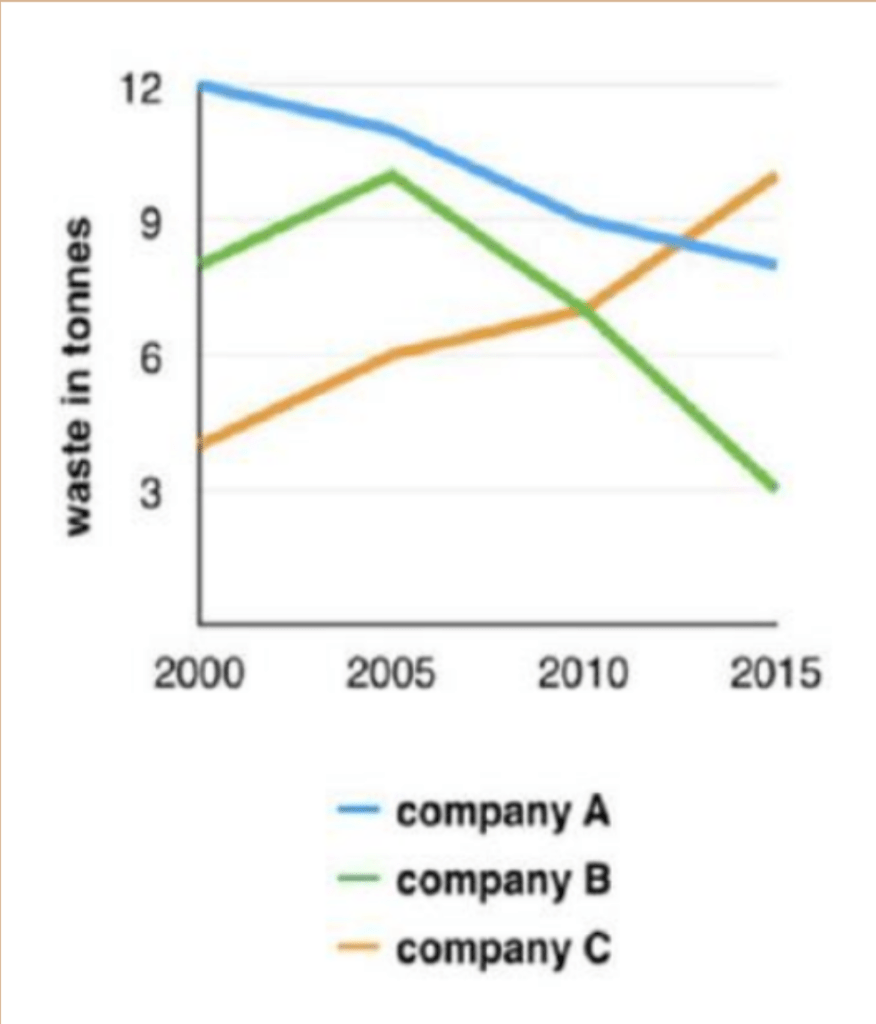
(Chart type: Line chart / Time-based comparison)
(Time division example: BP1 – 2000 to 2010, BP2 – 2010 to 2015)
Introduction:
The line chart compares how much waste was produced by three companies, measured in tonnes, over a period of 15 years between 2000 to 2015.
Overview:
Overall, it is clear that the total amount of waste production declined over the period. While the figures for company A and B saw a decline, the amount of waste created by company C increased considerably.
⭐ Body Paragraph 1
- Start with a comparison: How much waste did company A produce? How much more than B and C? (IELTS writing often emphasizes comparison)
- Describe trends: Explain the 5-year change – the decrease of A, the increase of B and C.
- Make a comparison point: Compare A, B, and C around the year 2010.
In 2000, company A produced 12 tonnes of waste, which was 4 tonnes and 8 tonnes more than company B and C respectively.
Over the following 5 years, the waste of company A decreased by around 1 tonne, while those of company B and C rose to 10 tonnes and 6 tonnes.
⭐ Body Paragraph 2
- Describe changes in trend for A and B.
- Highlight C’s trend and any key features.
- End the paragraph with a closing sentence.
From 2005 to 2015, the figures for company A and B saw a decline. The former decreased to 8 tonnes, while the latter dropped to 3 tonnes.
By contrast, company C saw a continuous increase in waste production, whose figure exceeded those for company B and A at 7 tonnes and 9 tonnes respectively.
By 2015, the amount of waste generated by company C reached its peak, with around 10 tonnes.
Here are some useful writing templates I’ve compiled:

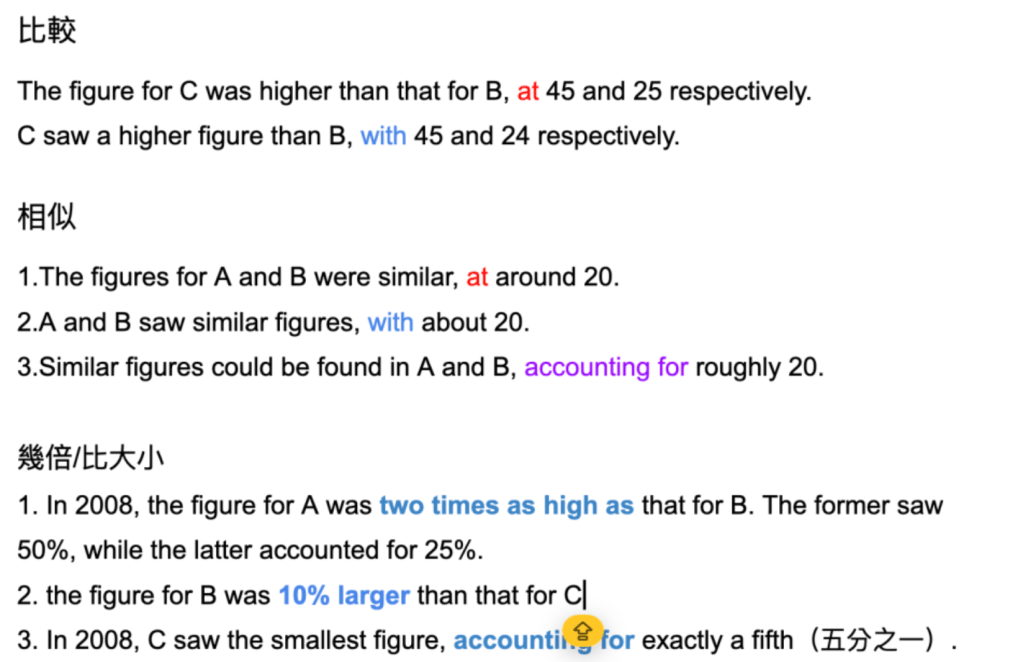
📝 Writing Task 2 – Argumentative Essay
This task is where most of your score comes from, so make sure to take it seriously!
💡 Key to scoring well:
- ✅ Clear opinion and balanced paragraphs (BP1 + BP2)
- ✅ Focused structure: Each sentence should have one central idea
- ✅ Logical flow: Structure your ideas clearly and avoid vague or unclear reasoning
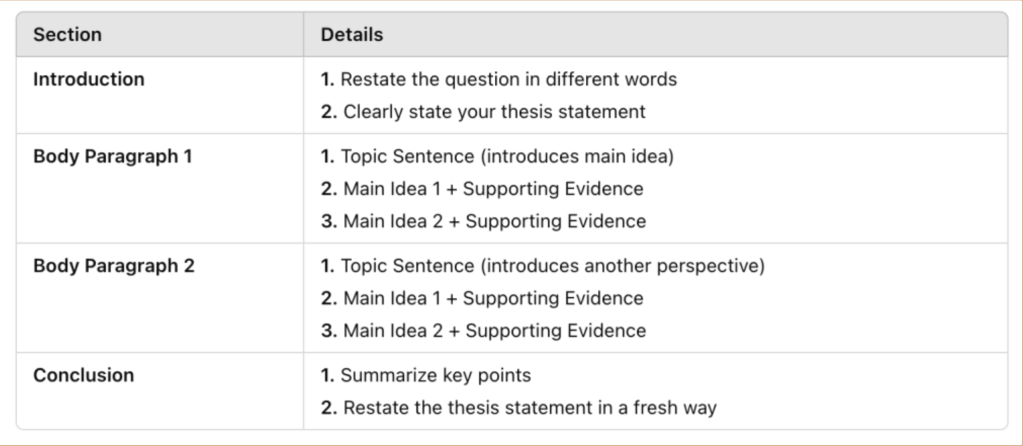
🧱 Basic Essay Structure:
- Introduction: Paraphrase the question + State your opinion
- Body Paragraph 1: Show your first main point and supporting evidence
- Body Paragraph 2: Show a contrasting or extra perspective
- Conclusion: Restate your opinion and summarize your reasoning
✅ Use linking words and cohesive devices:
although, despite, in contrast, as long as, similarly, on the other hand, however, in addition, afterwards, besides, but…
📍Example Task 2 Topic:
The working week should be shorter and workers should have a longer weekend. Do you agree or disagree?
🔍 Brainstorm before writing! Spend 3–5 minutes outlining your stance and major arguments.
Sample outline:
- Intro: Clearly paraphrase + State your thesis (e.g., I believe maintaining current working hours is important for society’s overall functioning)
- BP1 – For shorter workweeks:
- Better work-life balance
- Less stress + mental health improvement
- BP2 – Against shorter workweeks:
- Economic impact and loss of efficiency
- Hybrid work already provides flexibility
Conclusion (結論)
- Restate your position: Although reducing working hours can help improve work-life balance, maintaining the current working hours is more beneficial for economic growth. Moreover, hybrid working models already offer enough flexibility, so further shortening is unnecessary.
📌 Key Takeaways
✅ Pros (Supporting Shorter Work Hours):
- Hybrid working style
- Less stressful
- More time to develop interests
❌ Cons (Against Shorter Work Hours):
- Not good for economy & efficiency
- Hybrid work is already popular, so shortening the workweek is unnecessary
💡 If you’re stuck during practice and can’t think of arguments, feel free to ask ChatGPT for inspiration! 😌
For example, type:
I’m looking for some useful IELTS vocabulary + arguments related to AI & technology.

🌟 You can reuse content like this in your personal notes and apply them across different topics!
🔥 Time to switch to exam-prep mode!!
Wishing all test-takers the best of luck on IELTS—go get your dream score! 🌟✨
- 美國傳播行銷研究所申請心得|從背景到錄取經驗的完整分享
- How to Score 7.5 on IELTS|Complete Study Breakdown for All Four Sections
- 職場心態真相:別被「Toxic Positivity」騙了!
- IELTS 7.5 攻略|聽說讀寫四科實戰筆記
- 如何克服 IELTS 考試焦慮?從心態到實戰全面破解

HSIN

 HSIN'S BLOG
發表留言